© Edgar Ketzer
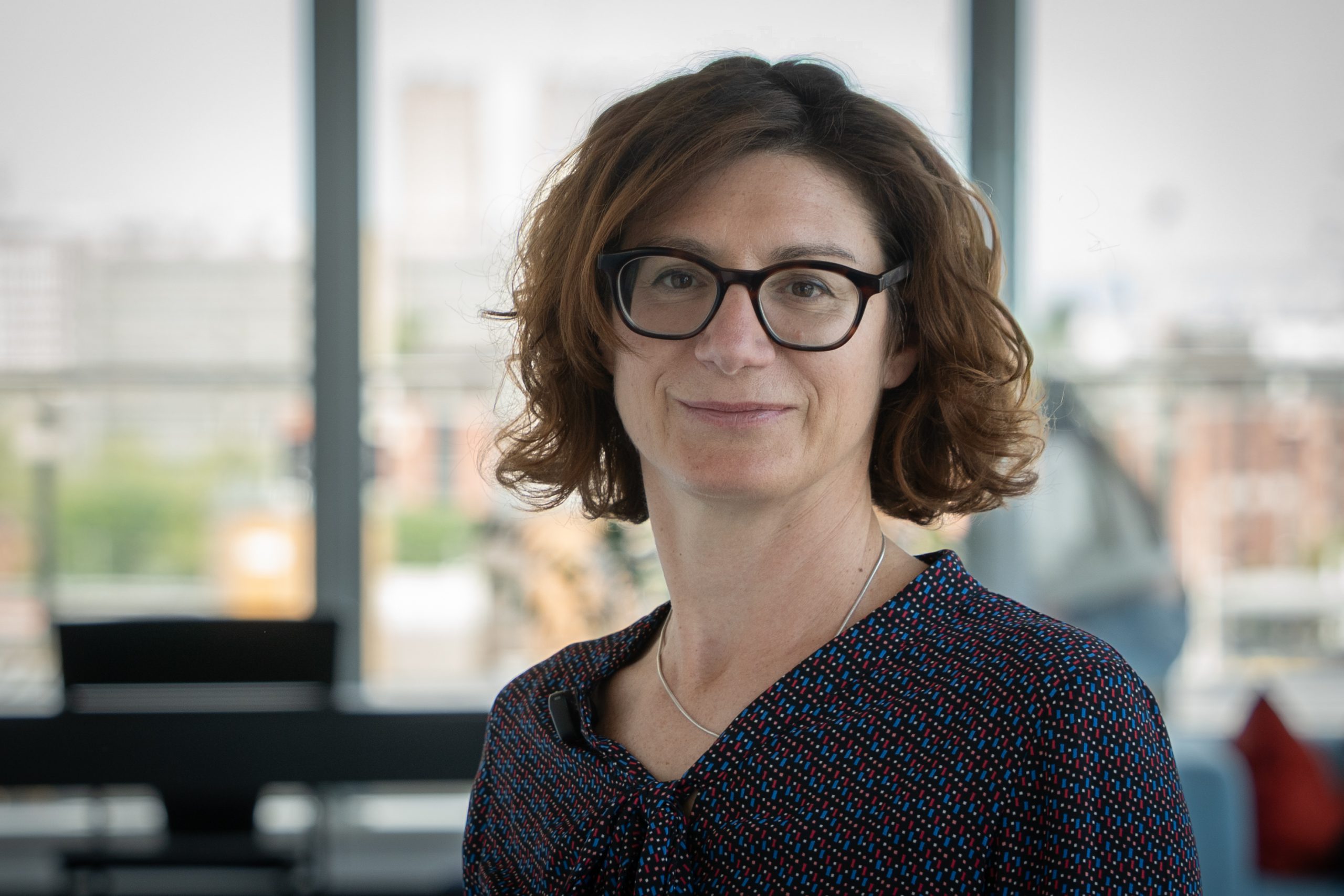
MariePierre Granger experienced political pressure in Hungary, the move to Vienna and the establishment of the first works council at the Central European University. Today, as chair of the works council, she campaigns for more transparency, better working conditions and democratic co-determination at the university.
Marie-Pierre Granger does not answer the question about herself by immediately starting with the beginning of her works council work, but goes further back. Born in France, she grew up in two worlds: “One part was bourgeois-aristocratic, but I lived with my mother and my stepfather. Both had left school early and were manual workers.“ Her mum was a seamstress and her stepfather a mechanic and an active trade unionist.
This gave Marie an early insight into social differences. During her studies, she also worked in harvesting: “I think all of this gave me a strong awareness of the obstacles different population groups are confronted with.”
Optimism in Hungary
After studying European law, she first taught in England. In 2004, she began teaching at the Central European University (CEU) in Budapest – in the same year that Hungary joined the EU. “I love it here because we have so many different backgrounds, both among the students and the staff.”
She experienced the city at the time as being on the move: “Back then, the enthusiasm and optimism were really tangible. One could never have imagined the political developments that would follow.”
Illiberal with a capital I
From 2010 onwards, under Prime Minister Viktor Orbán, the dismantling of rule-of-law institutions began. The model of “illiberal democracy” propagated by him also changed the social climate. “I noticed among my Hungarian friends that suddenly no one wanted to talk about politics anymore. Everyone was frustrated.”
Marie also experienced the problems in the health system first-hand: “I was seriously ill in a Hungarian hospital and almost died because there was a lack of everything.” At the latest then, it was clear to her that she wanted to leave the country. But Orbán pre-empted her plans. With a law referred to by critics as “Lex CEU”, the government de facto prevented the university from continuing in Hungary. Orbán had previously spoken out repeatedly against George Soros, the university’s founder, and had made what he called the “Soros network” into a political enemy image – using rhetoric that critics saw as drawing on antisemitic stereotypes. In the end, the university was forced to relocate to Vienna.
Starting in the works council
After arriving in Austria, Marie became part of the university’s first works council in 2021. Understanding all these new framework conditions was not so easy at first: “First, we had to learn what we as a works council can actually do and are allowed to do. Not only us, but also the employer.”
“We first had to learn what we as a works council can actually do and are allowed to do.”
Marie-Pierre Granger,
Chair of the Works Council, Central European University
The works council received support from the trade union: “As far as I know, we received the first all-English training for works councillors by the GPA trade union.” Contact with works councillors from other private universities also helped in order to exchange views on practice.
Family-friendly working
As one of its first successes, the works council introduced a model for family-friendly working at CEU, which is now being implemented university-wide. Working conditions are adapted in such a way that they meet the needs of colleagues with families. Another major issue for the works council is a flexitime agreement. This has now been negotiated. That was urgently needed, Marie explains, because “many colleagues de facto work in a flexitime model without there being any rules for it.” The agreement now creates, on the one hand, more security and, on the other, more flexibility.
“As a works council team from many different areas, we have a 360-degree view. Perhaps as the only place at the university.”
Marie-Pierre Granger,
Chair of the Works Council, Central European University
When asked about her works council team, Marie begins to speak very happily: “We come from many different areas of the institution and represent around 400 people. We are therefore probably the only place where people understand how the university really works.” She speaks of a 360-degree view that they have in the works council. As a result, the works council can quickly counteract duplication of work – for example, when evaluation processes for different staff groups are conceived completely independently of one another.
And there is already a next concern. In future, employees’ activity profiles are to be described in greater detail and in a more comprehensible way. “Often colleagues do not know whether they are correctly classified and paid fairly because the activity profiles are so unclear.” This also enables the works council to provide better support in its consultations. Because transparent activity descriptions are an important prerequisite, for example, for making a gender pay gap visible and closing it.
No collective agreement
Ultimately, however, the works council is concerned with more than just its own workplace: “We belong to the two per cent of employees in Austria who are not covered by a collective agreement.”
What is important to Marie in a future collective agreement for private universities is that it is not used by employers to lower salaries within the sector. This requires solidarity between the individual works councils, which are in intensive exchange with each other.
Democracy and the works council
From her perspective as a scholar, what does the works council have to do with democracy? “Good question,” says Marie. “At the beginning, we were told by the leadership level: The university is not a democracy. Of course, we did not accept that.” For the works council, there is no question that employees at a university, too, can have their say and help shape change. That is part of the democratic process.
Thanks to the pressure from the works council, there is now more exchange and transparency. From Marie’s point of view, however, further improvements are still needed here. This is precisely why the works council is essential, because, “as an established and legally protected institution, it is an important body for implementing more co-determination”. Marie and her colleagues will continue to work towards this. As she says at the end of the conversation conducted in English, the work in the works council is a “work in progress”.